


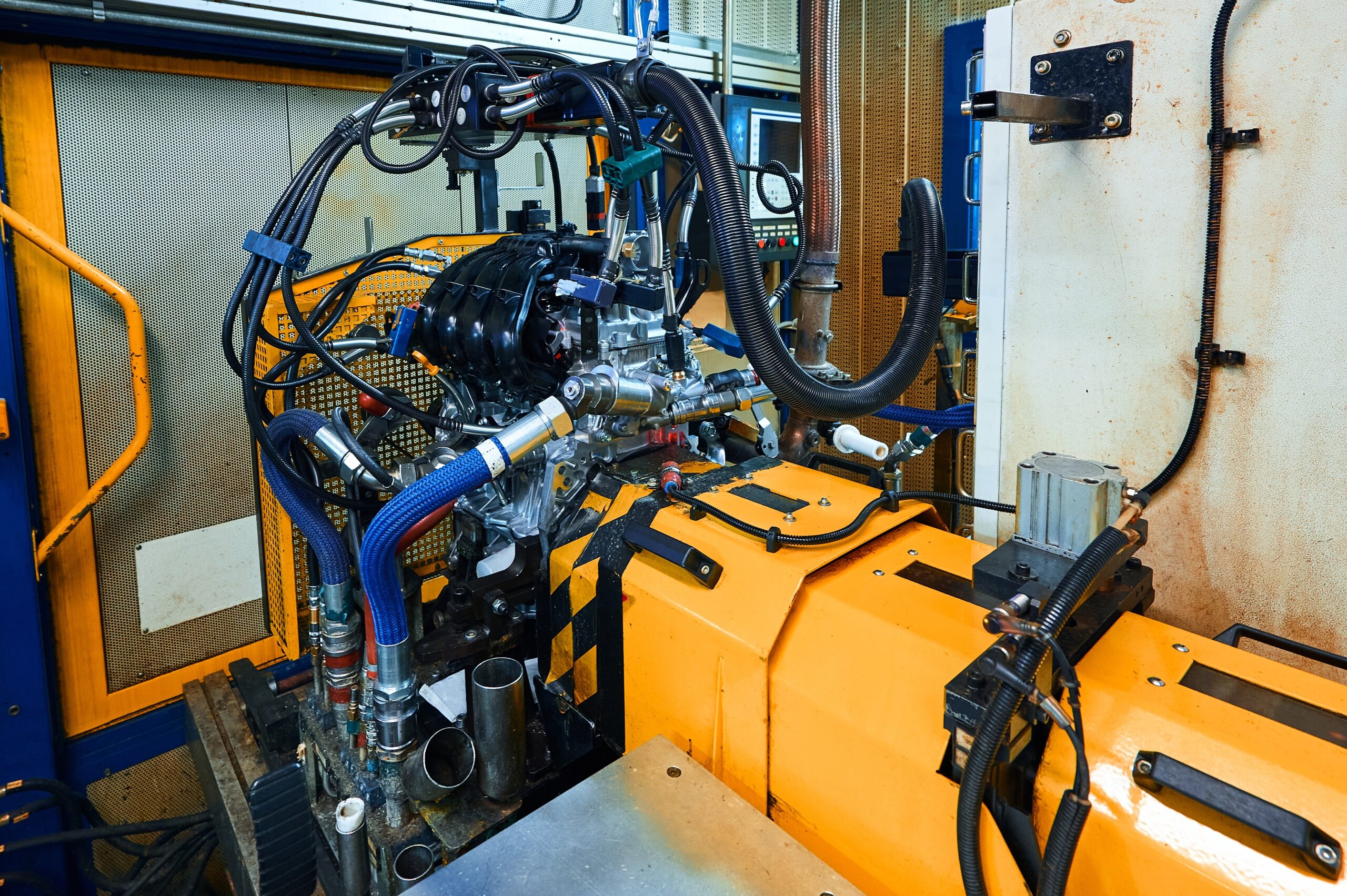
As of January 1, 2019, Regulation (EU) 2016/1628, including its amendments, came into effect. These regulations, also referred to as the Stage V regulations, require all engines installed in non-road mobile machinery to comply with the emission limits defined in Annex II of Regulation (EU) 2016/1628. These regulations are similar to the EURO VI regulations for Heavy Duty diesel engines. Non-road mobile machinery (NRMM) encompasses all mobile machines not intended for road passenger or goods transportation. This includes inland waterway vessels, agricultural vehicles, excavators, as well as generator sets and pump sets.
The approach to meeting the Stage V emission limits varies based on the engine application and power. To comply with most emission categories, the engine must be equipped with specific exhaust gas aftertreatment technologies such as DOC, SCR, and/or DPF, to maintain emission levels within the specified limits. However, it’s not sufficient to merely ensure the engine falls within these limits; it must also undergo testing to verify its compliance.
This article will concisely describe what it entails to certify an engine according to Stage V regulations. We assume the engine already meets Stage V emission requirements. Please note that this article provides an overview, and the homologation process involves many more aspects, documents, procedures, and actions. If you have questions or wish to delve deeper into the subject, feel free to reach out to us.
Step 1: Selecting the Engine Category
The first step is to select the engine category. The regulations define the following distinct engine categories:
• Category NRE: Engines for mobile non-road machinery, capable of being moved or propelled, not falling under any of the points below;
• Category NRG: Engines exceeding 560 kW used in generator sets;
• Category NRSh-SI: Engines with less than 19 kW power exclusively used in hand-held equipment;
• Category NRS-SI: Engines with less than 56 kW power not falling under Category NRSh;
• Category IWP: Engines exceeding 19 kW power for direct or indirect propulsion of inland waterway vessels;
• Category IWA: Auxiliary engines exceeding 19 kW power for use in inland waterway vessels;
• Category RLL: Engines for propulsion of railway locomotives;
• Category RLR: Engines for propulsion of railcars;
• Category SMB-SI: Engines for use in snowmobiles;
• Category ATS-SI: Engines used in all-terrain vehicles and side-by-side vehicles.
In each engine category, there are usually different power classes, each with its own emission limits. Below is an example from DieselNet showing the different power classes within the NRE engine category.

Source: https://dieselnet.com/standards/eu/nonroad.php
In some cases, it’s also possible to use an engine from one category in an application intended for another engine category. Generally, there are additional requirements associated with this.
Once the engine category is selected, you can move on to the next phase, which is typically considered the beginning of the homologation process.
Step 2: Selecting Approval Authority and Technical Service
Normally, a Stage V type approval is issued by an approval authority, and the engine is inspected by a technical service. An approval authority is a governmental body authorized to modify, revoke, or grant type approvals. These are often ministries or government agencies responsible for registering all matters related to transportation, although this is not always the case. For example, in the Netherlands, the approval authority is the RDW. Each country that is a member of the European Commission has one approval authority. It’s not mandatory to obtain type approval from the approval authority of the country where the manufacturer is located. There is freedom of choice in this regard.
Once you have chosen an approval authority, you also need to select a technical service. A technical service is an independent entity accredited by one or more approval authorities to assess engines and vehicles for conformity with relevant regulations. A technical service acts as an intermediary between the manufacturer and the approval authority and will be present during the homologation tests. They will also verify the accuracy of all documentation.
On this website, you can filter technical services accredited in each country. However, note that this list includes technical services that do not necessarily conduct NRMM Stage V type approvals.
Of course, it’s also possible to first select a technical service and then determine the countries where they are accredited.
Step 3: Selecting a Testing Laboratory
After selecting an approval authority and a technical service, you must also choose a testing laboratory. Many technical services have their own testing laboratories. However, it’s important to note that it’s not necessary to conduct testing exclusively at the chosen technical service. For instance, you
can opt to conduct tests in the manufacturer’s own engine test facility, or the technical service can participate in testing at another technical service’s facility.
Keep in mind that not every testing laboratory is suitable for performing Stage V homologation tests. The correct emission measurement equipment must be available, and it must be calibrated in accordance with the annex of (EU) 2017/654, together with the engine dynamometer. These requirements are not easy to meet, as the measurement equipment must adhere to certain sample frequencies and generally needs calibration on an annual, semi-annual, or sometimes
quarterly basis.
It’s also possible to perform homologation tests outside of a testing laboratory, for instance, when the engine is produced in very limited quantities, typically just a few units. In such cases, In-Service Tests can be conducted. This involves testing the engine when it’s installed in the machine it’s intended for.
Step 4: Compiling the Required Documentation
In addition to physically testing the engine or engines, various documents are also required. The primary document is the information document. This document contains detailed specifications about the engine, exhaust gas aftertreatment package, manufacturer, engine control, exhaust gas aftertreatment control, and more. Furthermore, a Conformity of Production Control Plan must be established. This plan, akin to ISO 9001 quality control, clearly outlines how the manufacturer will ensure that every engine produced by them is exactly the same as the engine on which the Stage V certificate was obtained.
Moreover, specific mandates are also required, detailing which party is the manufacturer, who the representative is, who the OEM (Original Equipment Manufacturer) is, and so on.
Step 5: The Homologation Tests
Once all the aforementioned steps are completed, it’s time for the homologation tests. These tests consist of various components. The most crucial tests are the actual emission tests. During these tests, the base engine undergoes a specific load profile, dependent on the engine category and application, and emission measurements are conducted.
However, even if these tests are successful, the engine isn’t officially homologated as a Stage V engine yet. OBD (On-Board Diagnostics) demonstrations must also be carried out. In these demonstrations, the technical service checks whether the control system (usually the ECU) provides the appropriate measures and warnings. Additionally, a CDmin test must be performed, but this applies solely to engines with SCR (Selective Catalytic Reduction) technology. In this test, AdBlue is diluted with water, and the NOx emissions of the engine must still fall within the relevant emission limits, multiplied by 2.25 or increased by 1.5 g/kWh.
Furthermore, a long-term test is required to demonstrate that the engine continues to meet emission limits even throughout its lifespan. For this purpose, determining the degradation factors of the engine is necessary. This can be done in various ways. Typically, the simplest but costliest approach is chosen, which involves undergoing the Emission Durability Period: This period varies per engine category; for instance, for NRE, it’s 8000 operating hours. During this test, it’s assessed whether the degradation of emissions remains within the defined limits over a span of 8000 hours. Throughout the durability period, at least ¼ of the respective durability period must be tested. Subsequently, interpolation can be carried out based on this test value. These tests can also be conducted through In-Service Testing.
There are also alternative methods to determine degradation factors. If you’d like to know more about this, you can always contact us for further explanation.
The approach to meeting the Stage V emission limits varies based on the engine application and power. To comply with most emission categories, the engine must be equipped with specific exhaust gas aftertreatment technologies such as DOC, SCR, and/or DPF, to maintain emission levels within the specified limits. However, it’s not sufficient to merely ensure the engine falls within these limits; it must also undergo testing to verify its compliance.
This article will concisely describe what it entails to certify an engine according to Stage V regulations. We assume the engine already meets Stage V emission requirements. Please note that this article provides an overview, and the homologation process involves many more aspects, documents, procedures, and actions. If you have questions or wish to delve deeper into the subject, feel free to reach out to us.
Step 6: Conclusion
Once all homologation tests have been successfully completed and all documentation is complete and approved, the technical service will submit all the data to the approval authority. Then, the approval authority will issue one or more type approval numbers, allowing your engine to be sold within the category for which the engine is certified.
Keep in mind that even after the certificate has been granted, the certificate still needs to be managed. For example, annual In-Service monitoring tests need to be conducted, and there could be visits from the technical service to verify Conformity of Production (COP).
All in all, certifying one or more engines is an intensive process. There’s a lot involved. If you want to certify an engine or have other questions related to NRMM Stage V regulations, you can always contact us. We’re here to assist you.